Why Your Trade-In Offer Is Almost Always a Rip-Off (And How to Fight Back)
Car dealers make more money on your trade-in than almost any other part of the deal. Here's how the trade-in game is rigged — and the exact strategy to get what your car is actually worth.
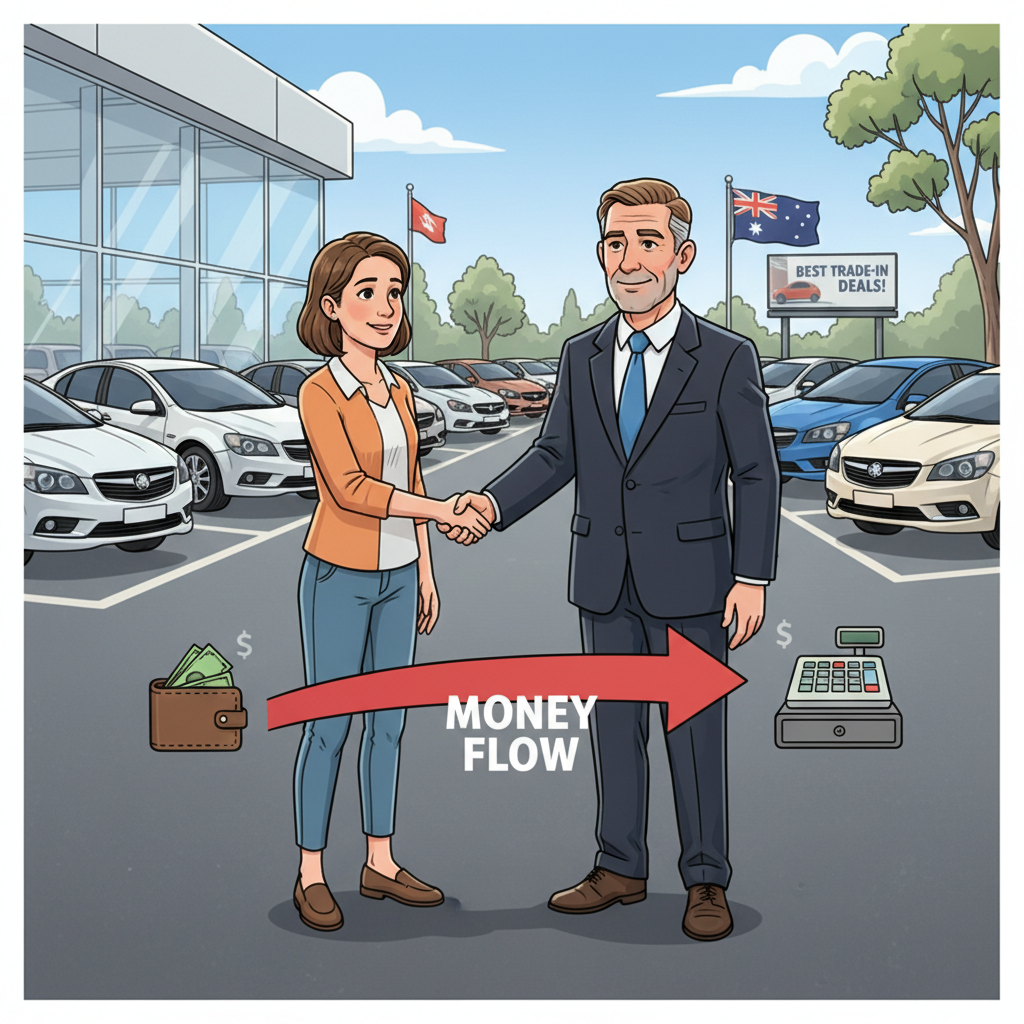
Here's a dirty secret the car industry doesn't want you to know: the profit on your trade-in is often larger than the profit on the new car they're selling you. While you're focused on getting the purchase price down, they're quietly pocketing thousands on the vehicle you're handing over. The trade-in is where the real game is played — and most Australians don't even know the game exists.
How the Trade-In Shuffle Works
Dealerships use a tactic called 'the four-square' to keep you from realising how bad your trade-in offer is. They focus your attention on four numbers simultaneously: purchase price, trade-in value, monthly repayment, and deposit. By negotiating everything at once, they can give you a bit here, take it back there, and make you feel like you won when you actually lost.
For example: you push the dealer on the purchase price and get them down $1,500. You feel victorious. What you missed is that your trade-in value quietly dropped $2,000 during that same negotiation. Net result? You're $500 worse off than when you started, and you're shaking hands like you just closed the deal of the century.
Always negotiate the purchase price and the trade-in value separately. Get the best price on the new car FIRST. Only then bring the trade-in into the conversation. This prevents dealers from using one to subsidise the other.
What Is Your Car Actually Worth?
Your car has three different values, and understanding them is critical. First, there's the private sale value — what a private buyer would pay for it. This is the highest figure. Second, there's the dealer retail value — what a dealer would put it on their lot for after reconditioning. This sits below private sale. Third, there's the wholesale value — what the dealer would pay at auction. This is the lowest number and is usually what they base trade-in offers on.
Most trade-in offers sit somewhere between wholesale and dealer retail. A fair trade-in offer should be close to the dealer retail price minus reconditioning costs (usually $1,000–$2,500 for a standard used car). If their offer is near or at the wholesale/auction price, they're simply buying your car to flip it at a significant profit — while also making money on the new sale.
The Real Numbers: What Dealers Make on Trade-Ins
Let's use a real-world example. You're trading in a 2018 Ford Ranger with 95,000km in average condition. The dealer offers you $18,000. After a $1,200 detail, minor service, and safety check, they list it on their forecourt for $26,500. They sell it within 3 weeks. They just made $7,300 on your trade-in — more than the margin on the new car they sold you. And you thought you were getting a deal.
The same Ranger in a private sale? Realistically worth $21,000–$23,000 based on current RedBook and Carsales listings. So by trading in instead of selling privately, you left $3,000–$5,000 on the table. That's a family holiday. That's wiping out a year of loan repayments. It's not a small number.
The Hassle Factor: Why People Trade In Anyway
There's a real reason people trade in despite getting less money: selling privately is a pain in the arse. You deal with time-wasters, lowballers, test drive liability, and the awkward handover. It can take weeks or months. Trading in is instant, clean, and simple. That convenience has a real dollar value — and it's completely valid to trade in if you price the convenience accordingly.
The problem is when people accept a bad trade-in offer while also thinking they're getting convenience. Know what the car is worth, know how much you're discounting for convenience, and make that choice deliberately. Don't let the dealer make it for you by obscuring the actual value.
How to Get More for Your Trade-In: A Step-by-Step Strategy
- Check RedBook.com.au: This is the industry standard for used car valuations in Australia. Get both the private sale and dealer trade-in estimates for your car's make, model, year, and kilometres.
- Check current Carsales listings: Search for the same car as yours. What are dealers charging for similar vehicles? This gives you their retail price — and helps you reverse-engineer what they'd be willing to pay.
- Get competing quotes: Use Carwow, Sell My Car, or simply ring two or three different dealerships for a trade-in quote on your vehicle. Even if you're only planning to buy from one dealer, competing quotes give you leverage.
- Clean the car properly: A $200 professional detail can increase your trade-in offer by $500–$1,000. First impressions matter — even to car dealers.
- Negotiate the new car price first: Agree on the purchase price before you mention the trade-in. Then negotiate the trade-in as a separate transaction.
- Be ready to walk: This is your single most powerful tool. If the trade-in offer is insulting and they won't move, tell them you'll sell it privately and buy from them with cash. Watch how quickly the offer improves.
What to Say at the Dealership
When the dealer makes their trade-in offer, don't respond immediately. Look at the number for a few seconds, then say: 'Based on current Carsales listings and RedBook, I was expecting something in the range of $X–$Y. What's the best you can do?' This signals you've done your research without starting an argument. It forces them to either improve the offer or explain why it's lower.
If they claim reconditioning costs are why the offer is low, ask them to itemise those costs. Most won't, because the real answer is just profit margin. If they do provide a list, you can push back on individual items — a tyre with 5mm of tread doesn't need replacing, for example.
General information only. This article is for educational purposes and does not constitute financial advice. Consider your personal circumstances and speak with a licensed financial adviser before making loan decisions.