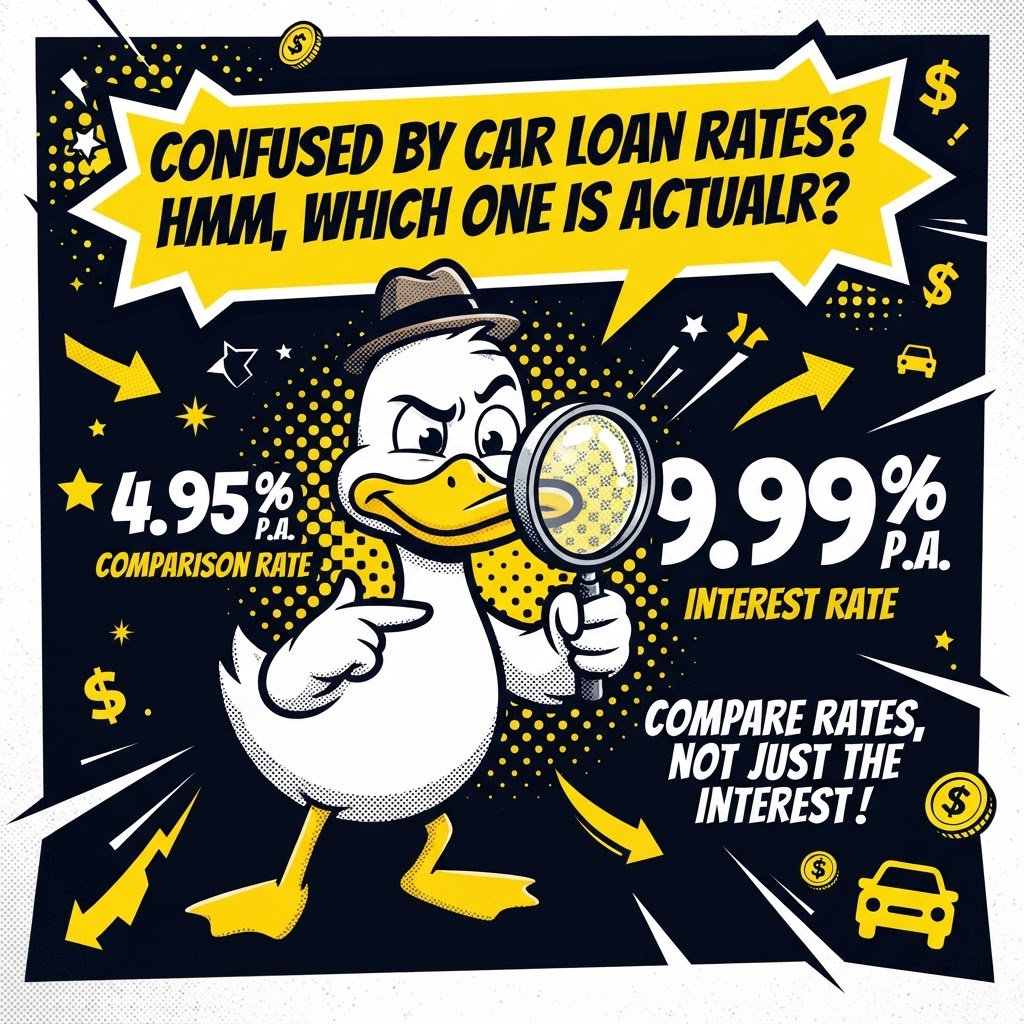
Comparison Rates Explained: The Real Cost of Your Car Loan
Think the interest rate tells you what your car loan costs? Think again. The comparison rate is the real number — we explain what it is and how to use it. 🦆
You've seen the ads. "Car loans from 5.99%!" Sounds ripper, right? Here's the thing — that number is the interest rate, not the comparison rate. And the comparison rate is the one that actually tells you what you'll pay. In Australia, lenders are legally required to display a comparison rate alongside any advertised interest rate. It's not a suggestion — it's the law. But most people don't know what it is, how it works, or why it matters. That's exactly how dealers and lenders like it. Let's fix that.
What Is a Comparison Rate?
A comparison rate is a percentage rate that includes the interest rate PLUS most fees and charges associated with the loan, rolled into one number. It's designed to show you the true cost of a loan, not just the shiny advertised rate.
Think of it this way: the interest rate is what they want you to see. The comparison rate is what you actually pay.
The comparison rate takes into account:
- The interest rate
- Application fees
- Monthly or annual fees
- Establishment fees
- Valuation fees (if applicable)
It does NOT include:
- Government charges (stamp duty, registration)
- Insurance premiums
- Late payment fees
- Early repayment fees
- Fee waivers or discounts that only apply to specific situations
So while it's not perfect, it's a hell of a lot more honest than the advertised rate alone.
Interest Rate vs Comparison Rate — What's the Difference?
Here's a quick example to show why this matters.
Let's say you're borrowing $30,000 over 5 years.
Lender A advertises an interest rate of 6.49%. Their comparison rate is 7.85%. Lender B advertises an interest rate of 6.99%. Their comparison rate is 7.12%.
Lender A looks cheaper on the advertised rate (6.49% vs 6.99%). But Lender B is actually cheaper when you look at the comparison rate (7.12% vs 7.85%). That's because Lender A is charging higher fees that aren't included in the interest rate.
Over 5 years, that difference adds up to hundreds — sometimes thousands — of dollars. The comparison rate is what helps you see that.
Why Lenders Must Display It
Under the National Consumer Credit Protection Act, Australian lenders are required to show a comparison rate whenever they advertise an interest rate for a consumer loan. This was introduced because lenders were advertising low rates with hidden fees that made the actual cost much higher.
The regulation is designed to stop lenders from making a loan look cheaper than it is. But here's the catch — it only works if you actually look at it and understand what it means.
How Comparison Rates Are Calculated
Comparison rates are calculated using a standard formula set by the government. The rate is based on a benchmark loan amount and term:
- $30,000 over 5 years for secured loans
- $10,000 over 3 years for unsecured loans
This standardisation means you can compare apples with apples — at least in theory.
The Trap: Comparison Rates Are Based on a Benchmark
Here's where it gets tricky. The comparison rate is calculated on a $30,000 loan over 5 years. But what if you're borrowing $50,000 over 7 years? The comparison rate shown might not reflect the actual comparison rate for your loan.
Why? Because fixed fees (like a $500 application fee) have a bigger impact on a small loan than a large one. On a $30,000 loan, a $500 fee adds 0.7% to the comparison rate. On a $50,000 loan, the same fee adds only 0.42%.
So the comparison rate is a guide, not a guarantee. It's still way better than looking at the interest rate alone, but you should ask the lender for a comparison rate based on your actual loan amount and term.
Red Flags: When the Comparison Rate Is Way Higher
If the comparison rate is more than 1.5% higher than the advertised interest rate, that's a red flag. It means the fees are significant and the advertised rate is misleading.
A gap of 0.5% to 1% is normal — that's just standard application and admin fees. But a gap of 2% or more? That's a lender who's hiding costs in the fine print.
Here are the most common red flags:
- High application or establishment fees buried in the comparison rate
- Monthly account-keeping fees that add up over the life of the loan
- The advertised rate is a "honeymoon" rate that reverts to a higher rate after 12 months
- The comparison rate doesn't include all fees (some lenders are creative about what counts)
How to Use Comparison Rates to Compare Loans
When you're comparing car loans, here's the process:
- Look at the comparison rate, not the interest rate. That's your starting point.
- Compare comparison rates across at least 3 lenders. Don't just go with the first quote.
- Ask each lender for a comparison rate based on your actual loan amount and term, not the benchmark.
- Check what's included in the comparison rate. Ask for a list of fees.
- Use a loan comparison tool to see the actual dollar difference. A 0.5% difference might not sound like much, but over 5 years on a $40,000 loan, it's real money.
Our Loan Comparison tool does the maths for you — plug in two loans side by side and see the total cost difference, including fees, over the full term. No fine print, no guesswork.
The Bottom Line
The comparison rate is the most honest number a lender will give you. It's not perfect, but it's a damn sight better than the advertised rate. If a lender won't show you the comparison rate, or if the gap between the two is massive, that's your answer — walk away.
Don't let a shiny advertised rate talk you into a loan that costs you thousands more than you expected. Check the comparison rate. Compare your options. And if something doesn't add up, run it through our tools before you sign anything.
Want to dig deeper? Read our guide on Dealer Finance vs. Bank Loan to see how dealers use the advertised rate to hide the real cost, or learn about Car Loan Fees Explained to understand exactly which fees get bundled into the comparison rate.
Already got a loan? Check your Loan Health Score to see if your deal is Bloody Ripper or Mate, Leg It — the comparison rate is a big part of that score.
Quick Answers
What is a good comparison rate for a car loan in Australia?
As of 2026, comparison rates for secured car loans typically range from 6.5% to 10%. Anything under 7% is competitive. Anything above 10% and you should definitely shop around. Your actual rate depends on your credit history, loan amount, and whether the loan is secured or unsecured.
Is the comparison rate the same as the interest rate?
No. The interest rate is the cost of borrowing the money. The comparison rate includes the interest rate PLUS most fees and charges, giving you a more accurate picture of the total cost. The comparison rate is always higher than the interest rate (unless the loan has zero fees, which is rare).
Do all lenders have to show a comparison rate?
Yes. Under Australian law, any lender advertising an interest rate for a consumer loan must also display a comparison rate. This includes banks, credit unions, online lenders, and dealer finance. If they're not showing it, they're not complying with the law.
Can I negotiate the comparison rate?
You can't negotiate the comparison rate directly, but you can negotiate the fees that make it up. Application fees, establishment fees, and monthly fees are all negotiable. Reducing those fees lowers the comparison rate. It also helps to have pre-approval from another lender as leverage.
What fees are NOT included in the comparison rate?
Government charges (stamp duty, registration), insurance premiums, late payment fees, early repayment fees, and conditional fee waivers are NOT included in the comparison rate. Ask the lender for a full list of fees so you know the complete picture.
Should I choose the loan with the lowest comparison rate?
Usually yes, but not always. The comparison rate is the best starting point, but also consider the loan features — can you make extra repayments? Is there an early repayment fee? Is the rate fixed or variable? The cheapest comparison rate isn't always the best loan for your situation.
General information only. This article is for educational purposes and does not constitute financial advice. Consider your personal circumstances and speak with a licensed financial adviser before making loan decisions.